jueves, 24 de mayo de 2007

Pantheon Hill to Bellavista Hill

Summary: An interesting walk with many important sites and many surprises. Major historical sites include the historic Dissident’s Cemetery, the Saint John’s Hill National Historic District, the Yungay Hill, the Eden Passageway, and Bellavista Hill.
Estimated walking time: Approximately 2 hours.

How to get here: Take a collective taxi or bus from the Plazuela Ecuador to the old prison site.

Degree of difficulty: Look out; this is a killer with several treacherous climbs, ideal for urban hikers with a hearty spirit of adventure. Not recommended for the weak!
Tourist infrastructure: You will find a series of pubs, restaurants, and soda fountains in the Plazuela Ecuador, about 2/3rds of the way. If you get to that point around meal time, you may want to detour one block to the historic Hamburgo or hold off another 30 minutes until you get to the end of the section. There you will find the Valparaíso Foundation headquarters and the excellent restaurant, El Gato Tuerto, with its spectacular terrace, eclectic fusion cuisine, and one of the best boutique wine lists in the region. The Hotel Puerta de Alcala, on Pyramid Street just of Plazuela Ecuador, is probably Valparaíso’s finest.

Catholic Cemetery Number 2

The least visited of the 3 cemeteries in Pantheon Hill; this beautiful resting place is still worth a visit. You can find tobacco industrialist Fernando Rioja, and many famous old civic leaders of Valparaíso, such as Ricardo Cumming, Enrique Deformes, and the Clark Brothers, considered pioneers of the Chilean railroads.

Catholic Cemetery Number 1

With its spectacular geographical setting, this is the eternal resting place of the Baburriza clan, José Francisco Vergara –the founder of Viña del Mar- Carmela Chacón (widow to war hero Arturo Prat), the Solaris (patriarchs of the Italian immigration in Valparaíso), Vice Admiral Simpson, the Edwards clan (founders of the El Mercurio Dynasty), and Renzo Pecheninno (Lukas), amongst many, many others.

Dissident’s Cemetery

This is probably Valparaíso’s most important ethnic heritage site, harboring the tombs of thousands of European immigrant who edified the city during her golden age. The austerity of the place reflects the powerful Anglo-Saxon presence that infuses most of the city’s institutions. Many tombs include anecdotes about shipwrecks, naval battles, and other urban pioneers. You will also find many of Valparaíso’s early Protestant, Lutheran, and Mormon leaders. Most tombs are English or German, giving tourist and otherworldly glimpse into the Anglo heart of this Latin City.

Saint John’s Hill

One of Valparaíso’s best kept secrets, the Lord Cochrane Housing Estate contains about twenty of the city’s most photographed and beloved homes. The houses line San John’s, Bernardo Vera, Placilla, and Vicente Padún Streets, respectively, and include various stairways and passages. The houses are all painted bright colors and in recent years they have been taken over by a new generation of up and coming civic activists, including the President and Founder of the Valparaíso Foundation! Climbing up Placilla Street, you walk down an alley towards Guillermo Rivera, alternating stately old homes with poorer new ones. At this point you connect onto tiny Huascar Street and wind your way up to General Mackenna, taking you to the heart of Yungay Hill. This is actually one of the Valparaíso’s most peaceful neighborhoods, since there isn’t too much traffic and the views are great. There is a beautiful plaza just above the intersection of Huascar and Mackenna. Take a look before strolling down General Mackenna to Ecuador Square. The last block and a half of General Mackenna is very steep and graced by a number of very attractive old homes. Be glad you are walking down!!! When you get to the plaza, be careful, because this is a dangerous intersection with lots of confusing traffic. You will want to turn to the right and walk up Yerbas Buenas Street. You are now heading up hill again, so it may not be a bad idea to buy yourself a soft drink in one of the stores on the plaza.

The Eden Passageway

About three blocks up Yerbas Buenas Street you will come across a stairway. (At the address 334, to be exact) This is the entry way to the strangely exotic Eden Passageway. To access, you first need to climb up about 50 steps, and then traverse the hillside laterally in a zigzag fashion. It is worth the effort! This little detour is a microcosm of the absurd and rebellious urban nature that makes Valparaíso so exquisite!After our detour on the Eden Passage, we return to Yerbas Buenas Street and walk down again, although not all the way. We are looking for an entry way on the other side of the street that says “Chopin.” This picturesque meandering stair will short cut us up to the Open Air Museum of Bellavista Hill.

Queen Victoria Elevator to the Old Prison

Summary: A highly recommended walk through the upper sections of the Pleasant Hill National Historic District, winding along the elegant German Avenue to Bismark Square, and down Cumming Street to the old prison, now an active cultural center.
Estimated Walking time: Approximately 2 hours.

How to get here: Leave your car in the underground parking at Lord Cochrane Square (Regional Government Building) and walk 3 blocks up through the Plazuela Aníbal Pinto up Cumming Street to the Queen Victoria Funicular. Any bus outside the bus station will take you as well. Get off at Bellavista Street in front of the Líder Supermarket. From there, walk the same 3 blocks across the plaza, through the Pazuela Aníbal Pinto, and up Cumming Street to the Queen Victoria elevator.

Degree of difficulty: Strenuous, especially the first stretch from the Queen Victoria Elevator up to Avenida Alemania. The rest is flat or downhill.
Tourist Infrastructure: There are some small stores and galleries on Almirante Montt Street, parallel to Capilla, at the beginning of your walk, but you will be hard pressed to find clean public bathrooms, so start with your tank empty.

Queen Victoria Elevator

At the end of Dimalow Promenade, you’ll find the Queen Victoria Elevator, inaugurated in 1902. This vantage point offers on of the most striking vistas in all of Chile.

Capilla Street

You come to Capilla after a short walk along an interesting cobblestone passageway that traverses the flank of Pleasant Hill. Capilla Street has some steep sections, but the European architecture will distract your attention. Eventually, you will come to a tiny plaza called San Luis, named for the nearby Catholic Church. Another side Street, called Galos Street (literally the Welshman) is also worth a look.

Avenida Alemania

We continue along Avenida Alemania (German Avenue) the beltway connecting the hills of Valparaíso. As you start your walk, you’ll see the old German Hospital. In the old days, every one who was anyone in Valparaíso was born at this hospital, including ex-presidents, famous poets, magnates, and diplomats.
After winding 5 blocks along the attractive beltway, you arrive at Biskmark Square. In front of the square you’ll find the stately Manuel Montt School. You will also find one of the most impressive 360 degree views you’ve ever seen.

Cumming Street

From the Bismark Square we head down Cumming Street to the old prison site, now a cultural center. Half way down you will find an attractive photo opportunity to the old Lord Cochrane Housing Estate, a dazzling display of the twenty or so high quality wooden houses, scaling the hillside. This area forms part of the St. John’s Hill National Historic District described in stage 4.

The Old Prison


Authorities have struggled to find the right plan to transform this historic penitentiary. The Guggenheim Foundation studied it as a finalist for their Latin American museum, but a large donation from a Brazilian industrialist ended that dream, in favor of Sao Paulo. Since that time, regional authorities have battled with government authorities in Santiago over a definitive restoration plan scheduled for the near future. In the meantime, the old cells can be visited during working hours. A series of old limestone tunnels located beneath the cellblocks and dating back to the early Spanish settlements, constitute one of the site’s most unique archeological features. Take a break.

El Peral Funicular to Queen Victoria Elevator

Summary: For tourists with limited time in Valparaíso, this is the walk you want to take. The Pleasant Hill and Concepción National Historic Districts constitute one of the most stunning and breathtaking cultural heritage sites in the world. The neighborhoods are well preserved and tourists friendly.

Estimated walking time: 90 minutes to 2 hours.
How to get here: By car you can follow the main routes into downtown Valparaíso, leaving your car in the underground parking below the Plaza Sotomayor. By bus or trolley, board any vehicle marked “Aduana” and get off the Plaza Sotomayor, walking 100 meters to the El Peral Funicular in the Justice Square.


Degree of difficulty: There is a slight climb up Miramar Street from the Yugoslavian Promenade to Lautaro Rosas Street. The rest is flat or downtown hill. You may need to catch your breath, but in general, this is an accessible walk for healthy people for all age.
Tourist infrastructure: Plenty. In Pleasant Hill, the Colombina is one of Valparaíso’s finest hillside restaurants with a lovely terrace and a fine wine list. In Concepción Hill, the Café Turri is well known and the Brighton Bed & Breakfast has one of the most spectacular hanging terraces in the city –ideal for meals, snacks, coffee, wine or a refreshing pisco sour. In general, any of the major restaurants will allow tourists to use the bathrooms as long as they don’t abuse the privilege. There are now several smaller cafés and restaurants, several of which may be worth stopping in to. On weekends, the French lunch at the Le Filou de Montpelier (Almirante Montt Street with Urriola) is one of the best bargains in all of Valparaíso. As for lodging, the Brighton is the best known, but you will also find a plethora of B & Bs and charming family-owned apartments for rent. The Tomas Somerscales Hotel is due to open in 2004.

The Justice Square. Natalislang's Office Location in Valparaíso

The section begins in Justice several feet away from the Plaza Sotomayor. If this is the only section of the walk, you may want to detain yourself for a few minutes in Sotomayor Square, the most important civic square in Valparaíso. More detailed information on the plaza, its buildings, and its institutions, is discussed in section 14 of this guide. The plaza extends naturally of the Prat Pier where massive commercial ships mix with tiny schooners. Local residents feeding the pigeons, mill with international cruise passengers buying curios in gift shop. In the center of Sotomayor Square is the impressive Monument to the Martyrs of the Battle of Iquique, the famous military battle the defined the future of Chile and sealed the fate of Bolivia and Perú. In 1879, Chile had been attacked by a confederation made up of its two northern neighbors, initiating the War of the Pacific. During a key battle, a Chilean wooden schooner named the Esmeralda was given the impossible task of stalling an iron Peruvian battleship called the Huascar in the northern port of Iquique until reinforcements could make it up from Valparaíso. It was a suicide mission. The heroism of the crew of the Esmeralda, led by Arturo Prat, turned the tide of the war and enabled Chile to annex from Perú and Bolivia the northern deserts that have generated most of the countries mineral wealth for the past 130 years. Sotomayor Square is built upon landfill and represents a significant archeological site. During recent excavations, workers uncovered the wooden dock of the first Prat Pier, dating to the mid-19th century. Other artifacts included ships ballast, old anchors, cannons, and pieces of shipwrecks, all gathered in an archeological museum housed beneath the plaza. Small tiles built into the plaza indicated where the shoreline was at different times in the city’s history. Returning to the Justice Building, we may be surprised at the curious statue of Lady Justice. While most courthouses feature a Lady Justice blindfolded and weighing the scales of truth, Valparaíso’s statue features Lady Justice with her eyes unobstructed and her scales dismantled. Legend tells that the sculptor was unhappy with a verdict involving his family. Other theories include the idea that the statue was a joke that never was corrected.

The Peral Funicular

Past the stately Interoceanica Building, you will find an opening that accesses the Peral Funicular, gateway to the Pleasant Hill National Historic District. Built in 1902, the upper station house was recently rebuilt and inaugurated in 2000. As the principal entry point into the Pleasant Hill (Cerro Alegre) National Historic District. This is one of the busiest elevators in Valparaíso. At the top, you enter the Yugoslavian Promenade. This is one of Valparaíso’s five most characteristic promenades, offering a spectacular view of the port, banking district, and neighboring hillsides. The dominating feature of this park is the outstanding Baburriza Palace, now the city’s fine arts museum. Pascual Baburriza was a Croatian immigrant who arrived in Chile to sell fish in the nitrate fields of Northern Chile. A classic entrepreneur, he expanded his enterprise, ultimately controlling thirty percent of the world’s nitrate market, later diversifying into railroads. Luckily, Baburriza sold his nitrate stock to the American Multinational Guggenheim Brothers just before the industry fell out during Word War I. Baburriza’s fortune was unscathed. Baburriza had two principal properties in this region: his Valparaíso palace and his summer estate twenty minutes to the interior. The latter has since been restored and donated as Chile’s national botanical gardens, worth a visit in its own right.

Baburriza Palace

This beautiful structure was built in 1916 by the Zanelli family and was designed by the Italian architects Barrison and Schiavon, who immigrated to Valparaíso seeking restoration work after the earthquake of 1906. Specialists in Arte Noveau, these beloved architects left behind a priceless legacy encompassing many classic buildings and homes in Valparaíso. But it was the Baburriza Palace where they found their true voice and style. Once the building was completed, the Zanelli family brought in the finest parquet, marble, and furnishings from Europe. Baburriza, sitting on a fortune after getting out of the saltpeter industry just in the nick of time, bought the palace in 1925. As an art museum, the collection features Chile’s finest collection of European painters.

Plazoleta Joaquin Edwards Bello

Although may consider the park next to the promenade to be an extension of the esplanade, it is actually called the Plaza Joaquín Edwards Bello, named after a beloved writers who immortalized Valparaíso in texts such as Valparaíso, the Windy City and The Old Almond Grove. Next to the plaza you’ll find the fine Colombina Restaurant, actually situated in the old servant’s headquarters of the Baburriza Estate. The stairway off to the left is called Apollo Passage, and features several attractive buildings. If you head down this stair, cross the street at the bottom, and climb the stair on the other side, you can short cut your way ahead to Concepción Hill. But we wouldn’t recommend it; you miss too much spectacular scenery.

Miramar Street

The trail continues to the cobblestone alley called Miramar Street, which opens up to some of the most stunning urban landscapes in all of Chile and, perhaps, Latin America. At the first cross street, visitors can stop to snap pictures of the “cruise ship house,” a classic example of Valparaíso corner architecture. Many people like to compare Valparaíso with San Francisco, but this curious intersection illustrates many of the differences between the two cities. San Francisco, for all its charm, is nonetheless a grid pattern city. Valparaíso, on the other hand, is a rabbit’s warren of organic urban development, where streets sinuously carve their way through the ravines. In such a world, the architecture must adapt itself to cling to unusual spaces left by the irregular curves. Many of Valparaíso’s most outstanding architectures masterpieces are those built on irregular intersections such as this one. To the left of the cruise ship house, you’ll find another oddity: The Bavestrello Passage, basically a public stairway that cuts through a private building. This curiosity illustrates another one of Valparaíso’s urban attributes. Other Chilean cities were built off a Spanish central plan and the roads were built by the government. In Valparaíso, the city was founded without a central plan and the principal alleys, stairways, promenades and streets were actually edified by the people who lived there.
Continuing up sloping Miramar Street, past lush Mediterranean vegetation prospering on the hillsides, you will come upon an exquisitely restored apartment complex on your right. Formally a finishing school for English girls, the house had been completely abandoned only to be recently restored in recent years.

Lautaro Rosa Street

Widely considered the most chic address in Pleasant Hill, Lautaro Rosas gives a nice idea about the quality of life for many of immigrant families living here between 1860 and 1930. Many of the houses on the left side of the street, like the finishing school, were restored by a single individual: a young German engineer who worked for the World Bank and lived in Valparaíso in the late 80’s and 90’s. Lautaro Rosas also features a nice art gallery, the Villa Toscana Convention Center, the Balmaceda 1215 cultural organization, and a Swedish restaurant.

Templeman Street

On a sunny day, one could easily spend hours strolling around the back streets of Pleasant Hill, but if you want to keep on track, we recommend you follow the route as it descends the stairway known as Templeman Street. As you cross Urriola Street you leave Pleasant Hill. The house o the left corner of Templeman and Urriola was used for a famous Chilean movie called “The Moon and the Mirror.” The route turns left on Urriola Street for about 100 meters and then enters an opening on the right called the Templeman Passage: a world inside a world.

The Galvez Passage

The most singular aspect of the Concepción Hill National Historic District is this unique system of interconnecting alleys. Following the signs through this zigzagging heart of Valparaíso, you are sure to become convinced that Valparaíso is as unique a place as exists anywhere in the world. Eventually you will come upon the Tomás Somerscales Hotel, with its restaurant El Mesón de Jorge. You will also find an Italian restaurant called Puerto Escondido. In front of the main entry to the hotel and restaurant, the alley culminates in a short stairway. The trail leads up the stair and takes a sharp turn to the left. You are now entering the Gervasoni Promenade, one of the most romantic vantage points for observing the bustle of the city.

Gervasoni Promenade and Café Turri

In addition to a romantic air and breathtaking views, The Gernasoni Promenade has four principal attractions, The Foundation Lukas, a house that was the first Danish Consulate in Latin America, The Concepción Funicular and the Café Turri. The Lukas Foundation is dedicated to Renzo Pecchenino, a beloved Italian immigrant who served for years as the caricature artist for El Mercurio newspaper. Known professionally as Lukas, Pecchenino was a brilliant artist who dedicated his life to drawing Valparaíso as it must have appeared during different periods of the city’s 480-year history. His excellent technique, poignant sense of humor, gregarious charm, and eccentric personality has led Chileans to identify Lukas as a genius of almost Neruda-like stature. A copy of Lukas’s drawings of Valparaíso, Apuntes Porteños can be purchased at the museum and makes an excellent souvenir to remember your visit to Valparaíso.
The Middle house of the promenade was the first Danish consulate in Latin America, opened in 1848. Across the street, the Concepción Elevator welcomes visitors up from the heart of the financial district. This is the oldest funicular in town, built in 1883, and makes an excellent detour, since the banking district below has much outstanding architecture of its own right, including the emblematic Turri Clock. At the end of the promenade, the Café Turri has been receiving happy tourist for almost 15 years. This was Valparaíso’s first hillside restaurant. Its owner, Raúl Alcazar, has been a proponent of the rebirth of Valparaíso fighting for the city against enormous odds. If you aren’t hungry, the terrace is ideal for a cup of java or a bottle of fine Chilean wine.

Atkinson Promenade

Our route continues along Papudo Street and the juts to the left to enter into the Atkinson Promenade, one of Valparaíso’s most splendid and surprising esplanades. The Atkinson Promenade is named after Juan Atkinson, a ship builder who built the homes here. By 1886, all of the homes were occupied and the neighborhood gained fame as an excellent place for an afternoon stroll. The great poet Rubén Darío, rumored to have rented the last house on the street, described the place in his book Album of the Port. The houses were occupied by German and British families, including the Eltons, the Boyes, and one of the city’s finest architects, Alfred Vargas, who built the Valparaíso Theater and Couve Gallery in Viña del Mar. The houses on Atkinson Street have not changed much, though the horrendous Student Solidarity Bank Building, built in the late 60’s, stole away much of the ocean view that made the promenade famous. At the end of the promenade, an iron railing offers an excellent vantage point to observe the Aníbal Pinto Square, with its pondering Neptune statue meditating in front of the Café Riquet, the last of Valparaíso’s great old cafes. Precisely in this space, the now extinct Esmeralda Funicular efficiently connected the promenade to the plaza. The elevator was damaged beyond repair in the 1985 earthquake. Today only the stone foundations remain.

Brighton Bed & Breakfast

The last house on the Atkinson Promenade is the charming Brighton Bed & Breakfast, rebuilt from recycled materials in 1996 by a Dutch immigrant, Case Tijmons and the architect Raul Haivar, who has been present in many noteworthy restorations in recent years. The house was purchased half-finished by Nelson Morgado, an architect who lived many years in Barcelona. Nelson had the idea of converting the advantage of one of the most splendid terrace in all of Chile. It didn’t take long for the tiny hotel, which boats seven small rooms, to become an icon. Live tango and boleros on weekends make the Brighton an excellent alternative for visiting romantics. Nelson Morgado, an active civic leader who has defended the Valparaíso renaissance in good and bad times, is also the owner of the Vila Toscana Conference Center in Lautaro Rosas Street.

Lutheran and Anglican Churches

A slender passage, named after German Minister Pastor Schmidt, connects the Atkinson Promenade with the attractive Lutheran church. Built in 1898, this is the most significant Lutheran church in all of Chile, providing spiritual support to the large Germanic population in Valparaíso during the early 19th century. Architecturally, the church favors a dignified austerity that compliments the religion’s belief in simple meditation over gaudy ornamentation. Nonetheless, the woodwork is splendid and the wooden Christ, sculpted by the German artist Peter Honre, is worth a look. The church’s bell tower makes a reference point when gazing upon Concepción Hill from the cemeteries or from the Dimalow Promenade, later in the route.
Our path now follows Abtao Street toward St. Paul’s, the Anglican Church of Valparaíso, and the German School. The preeminence of many British families in Valparaíso created certain problems for the Catholic aristocracy in the early 19th century. At the time, to avoid standing out, many Anglicans preferred to celebrate their religious rites in the homes of Pleasant Hill. In 1857, the British Consul, William Rouse, began organizing raffles to buy the land where St. Paul’s now stands. The Archdiocese of Valparaíso approved the building of a church of a competing faith, only after significant haggling and pressure. One of the most curious preconditions was that the doors of the Anglican Church should be smaller than the doors in Catholic churches. For this reason, St. Paul’s has no main entryway. To this day, the only way to enter the church is through two small doors on the sides. Although the church was built in 1858, the law didn’t recognize it officially until 1869. Nonetheless it is considered to be the first Anglican Church of the South Pacific coast of Latin America. The architect was William Lloyd, who came to Chile to build the Santiago to Valparaíso railroad. The spectacular pipe organ, donated to honor the visit of Queen Victoria, was built by Craig Christie. Pipe organ concerts are given every Sunday at 12:30.
St. Paul’s exquisite woodwork offers a world class acoustical experience. The church is used for choral concerts and occasional operettas. On the far side of the church is the “Walkway of the fourteen benches,” for the fourteen stone benches carved into the walls. In the old days, it was essential for each ethnic group in Valparaíso to have its own school. The British had the Mckay School in Pleasant Hill, and the Italians the Scuolla Italiana downtown. The handsome German School, across the street from St. Paul’s, was founded in 1857 and is officially the second oldest German high school in the world outside Germany. Several years ago, the school was moved toward a section of Viña del Mar. The old campus is rented to another school and possesses a fantastic auditorium which reflects the greatest influences of the Belle Epoque in Valparaíso.
In this section, the route also crosses the Music School of the Catholic University of Valparaíso, and the Pierre Loti Passage, named after the French novelist who spent time in Valparaíso. At the corner of Urriola Street, we find a small soda fountain called “Le Fillou de Montpellier.” Opened by a young immigrant from France, this tiny restaurant is famous for its inexpensive French lunches offered exclusively on weekends.

Dimalow Promenade

We enter the almost imperceptible Dimalow Promenade across from the bakery and Le Fillou de Montpellier. Like many of Valparaíso’s promenades, the stroll initiates with a series of attractive homes overlooking the ocean. Nonetheless, as we approach the midway point of the esplanade, we begin to note that something about this street is different. At the end of the alley, we find ourselves in one of the most spectacular vantage points imaginable. Standing in front of the Queen Victoria Funicular, the promontory of Concepción Hill, with the spectacular steeple of the Lutheran church, is exposed to view. Take a deep breath and enjoy this outstanding photo opportunity. This is the end of section 3. For those of you who want to double back to your standing point, you may ride down this elevator and walk one block down Cumming Street to the tiny Aníbal Plaza Square. This is the beginning of section 14, which makes a perfect circle of the historic quarter, taking you back to Sotomayor Square (beginning of section 3) or all the way to Echaurren Square and the beginning of section 2.

Artillery Elevator to Justice Square

Summary: This section zigzags through much of the older section of Valparaíso’s historic quarter, declared a UNESCO world heritage site. The area around the Echaurren Square and the base of Santo Doming Hill, surrounding the Church of the Matriz constitute outstanding cultural heritage sites. Still, hikers should aware this is the poorer section of the historic quarter (section three is much better preserved) and a certain spirit of adventure is recommended.

Estimated Walking Time: 90 minutes to 2 hours.
How to get here: take any of the buses on Errázuriz or Pedro Montt Street that says “Aduana”. Better yet, take a trolley. Get off at the Aduana and ride the funicular to the top of Artillery Hill.
Degree of Difficulty: This section features two significant climbs: one in Santo Domingo Hill and one in Cordillera Hill. The first can be avoided by shortcutting from the Plazuela Santo Domingo directly to Cajilla Street via Ullyses, eliminating the ascent. Still, wear comfortable shoes and avoid heels at all cost.

Tourist Infrastructure: There are cafes, restaurants, artist stands, and public bathrooms around the 21st of May Promenade at the beginning of the route. Once you get started, you may not find another clean bathroom until the Plaza Sotomayor, so start with an empty tank! There are a numbers of “picadas” (cheap, unglamorous restaurants recommended only to the most adventurous) around the Market place in Echaurren Square. At the end of the section you will find yourself at Sotomayor Square. At the end of the section you will find your self at Sotomayor Square, in the heart of the Valparaíso Financial District, with many amenities and fine restaurants galore.

Artillery Elevator

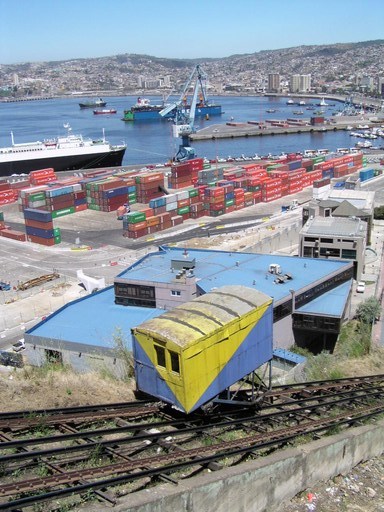
Built in 1893, the Artillery Funicular is the second oldest in Valparaíso and was once the busiest, actually possessing four cars that moved up and down on two parallel tracks. The wooden cars, together with those of the Baron Funicular, are the largest in Valparaíso. Originally, this elevator worked on coal.


Café Mirador

In the ex-machinist’s house you’ll find the Café Mirador. The café’s owner is Danilo Bruna Tello who has adorned the place with antiques, photographs, paintings, fluted bottles, keys, and old sewing machines, all brought together by attractive woodwork and a distinct maritime motif. At the end of the dining area you can actually gaze into the wheelhouse and see the machine work of the funicular in action. The café specializes in shrimp and cheese empanadas. He also sells a couple of specialty coffees, including cognac and chocolate, amongst others. “I’d always imagined a café like an anchored boat,” he says.

The House of the Artillery Hill:
The Grand Legacy of Barrison & Schiavon


One of the most photographed houses in Valparaíso is the stunning Victorian hanging from the precipice of Artillery Hill, just outside the station house of the Funicular. The house is inspired by the Harrington style and was one of the last homes of that period after the edification of the passage of the same name. This particular home was built between 1908 and 1909 for Don Wenseslao Campusano, a high level functionary at the custom’s house. The architects were two Italians, Arnaldo Barrison and Renato Schiavon; two architects recently arrived from Genova inspired by the thought of putting their expertise in historic restoration to work after the earthquake of 1906. Barrison and Schaivon brought to Valparaíso knowledge of European art Noveau, which had to be adapted to the conventional tastes of the porteños. They also needed to learn to adapt their constructions to the steep hillsides.
Barrison was born in Venice in 1883 and was educated in a family of artists and musicians. He studied architecture in Trieste and it was there where he met Schiavon who would become his inseparable friend and partner. These two architects later worked with José Smith Solar, author of the Santa María University. Barrison’s most noted work in Valparaíso is, without doubt, the Baburriza Palace in Pleasant Hill, whose spectacular Art Noveau styling could only have come from an expert.
Constructed in 1916, the Baburriza Palace was completed the same year that his two years Chilean wife, Mercedes Gonzalez, passed away. Other important works by this famous architects cited in this book include the Severín, La Casa Peraga, and the spectacular Rivera Palace with its notable onyx stairway.
Later, Barrison and Schiavon would go their separate ways.
Barrison’s later works would include the Rivoli Theater on Victoria Street (1921), the Monumento de los Caídos (Monument to fallen Italian heroes), the restoration of the San Juan Bosco School, the Hotel O’Higgins in Viña del Mar, the Carrera Theater in Quilpue, and numerous elegant homes in Viña del Mar and Recreo. He was buried at the Playa Ancha cemetery at the age of 87. His partner, Schiavon, was born in Pola in 1887. After meeting Barrison in Trieste, he decided to try his luck in Valparaíso. He worked as an artist for various newspapers and magazines. He married in the Italian Valparaíso community and became a professor of architecture at the Catholic University of Valparaíso. Schiavion’s major later works included the Banco de Chile on Prat Street, The Pompei Theater in Villa Alemana and the Municipal Theater of Viña del Mar. He passed away in 1945. Barrison and Schiavon will always be remembered for their priceless legacy in Valparaíso.

Artillery Passage to the Custom House

From the 21st of May Promenade the route extends down the stairway past noble, but dilapidated houses until arriving at Carampangue Street, which leads us to the Custom House. Carampangue Street was originally named “The Ravine of Juan Gómez” in honor of one of the city’s first police chiefs. In 1871, it was change to Carampangue in honor of a famous military battle. In one of these old houses Chile’s first professional soccer team, “Santiago Wanderers,” was founded in 1892. Why is called Valparaíso’s professional soccer team Santiago Wanderers? Simple. At the time of their founding, there was actually an amateur club team called Valparaíso Wanderers. That team has disappeared, and Santiago Wanderers of Valparaíso is now the deacon of Chilean soccer. The rout heads down Carampangue until Custom House Square, also known as Plaza Wheelwright in honor of the great Bostonian venture capitalist who financed the Chilean railroads and founded the mythical Pacific Team Navigation Company.

Bustamante Street

The Custom’s House, a national monument, constitutes a rare example of colonial architecture in the city. The most celebrated functionary was Rubén Darío, a great Nicaraguan Poet considered to be the father of modernism in Latin America. Darío rented an apartment off the Atkinson Promenade in Concepción Hill and wrote, in Valparaíso, the book “Azul” (blue), a masterpiece in Latin American literature.
From the Custom’s House, our route continues to via Bustamante Street, entering a neighborhood that once was known as Valparaíso’s “Chinatown.” Curiously, there is nothing Chinese about Chinatown in Valparaíso. Such a “politically incorrect” moniker actually refers to a zone historically associated with sailor bars and bordellos. The most famous bars included the now defunct American Bar and Roland Bar, often frequented by sailors, college students and Nobel laureates (Neruda). The only remaining bar echoing its forefathers today is the Flamingo Rose. Hungry? Try the Sethmacher Sausage Shop, a family business making homemade cured meats for more than 60 years.

Echaurren Street


This is the historic birthplace of Valparaíso and contains many notable buildings including the historic Market Place. The dilapidated marker offers cheap seafood for adventurous travelers. The more hygienic of these ma and pa eateries are located on the first floor and across the street, such as the “Marisquería Las Porteñas,” which at least offers some clean bathrooms and a bit more acceptable ambience for more conservative tourists.
Most buildings around the plaza date to the mid-19th century, including old emporiums and pharmacies that are worth a visit. The “Emporio Echaurren” is one of the most legendary old groceries in Valparaíso and has a fanatically faithful clientele that enables the owners to stock some fine premium wines and many European gourmet products that may, at first sight, seem out of place in such a working class neighborhood. Along the sidewalks, street vendors hawk cinnamon, oregano, paprika, and old fashioned stove toasters. Many of the stores in this neighborhood supply ships during their stays in the port of Valparaíso. As you gaze upon the bustle of this historic center, you will inevitably discover various eccentric personages such as the organ grinders or old ladies feeding the pigeons. It’s hard to imagine that what is now a chaotic urban center once was a sandy beach and that it was precisely in this spot 480 years ago, that the wooden schooner, Santiaguillo, captained by the Spanish explorer Juan de Saavedra, touched ground as the first European to set foot in what later would became Valparaíso.

The Church of the Matriz


A hundred or so meters behind the Echaurren Square stands the noble and stark steeple of the Church of the Matriz. The church and its tiny plaza serve as the gateway into the Santo Domingo Hill National Historic District, a labyrinthine hodgepodge of alleys, tiny pedestrian plazas, and almost vertical stairway with some exquisite old houses left among what is today one of Valparaíso poorest neighborhood. The most peaceful time to stroll in this neighborhood is early morning, especially Sunday, around mass at the church.
The Church of the Matriz, declared a national monument in 1971, is possibly Valparaíso’s most significant icon. The original version of the church was built in 1554 and in 1578 was sacked by the legendary corsair Sir Francis Drake. In 1615, it was sacked again by the Dutch pirate George Spilbergen. Earthquakes eventually did away with the church, obligating the community to erect a replica in the 17th century. That version too, was downed by earthquakes. In 1837, work began in the third version of the church, which remains in tact today. The finished church was originally baptized “Our Lady of Mercedes of Clear Port,” but later was changed to “The Parish of the Savour of the Matriz.” The austere elegance of the church contrast with its current use as a social center that attends to the poorest and neediest of Valparaíso’s impoverished.
Nonetheless, many Catholics from around Chile enjoy celebrating mass here, independent of their social standing, due to the quaint ambience and historic relevance of the parish. The neoclassical adobe facade with three doors and the octagon-shaped steeple of this church have become icons, not only in Valparaíso, but all over Chile. A row of quaint wood and adobe houses, with exquisite balustrades and balconies, complements the plaza and serves as the entrance into Santo Domingo Hill.
Inside the church, constructed in three naves, you can find an important 17th century Spanish caving, dating to the School of Seville and donated by the King of Spain. The sculpture was intended for a church in Santiago, but, as a legend has it, the Christ refused to leave the Church. When they finally got it out, the oxen refused to budge an inch to initiate the trip to Santiago. Neighbors considered this as a sign from God and the statue of the Christ has not been moved since. From the Church we continue down Santo Domingo Street toward a tiny plaza known as Santiago Severín. The beautiful Building on the corner originally belonged to the Company of Jesus, and in 1767 was transferred under the title Temple Santo Domingo. In this building civic leaders met to form the first town meeting, and in the first years after the Chilean Independence the building also served as meeting place for the provisional national congress. Several years ago, the building was taken over for use as a police station.
Looking back from the Plaza Severín toward the tower of the Church of the Matriz, the writer Augusto D’Halmar once wrote, “With its ancient gallery of stone, its old steeple, its cobbled streets and balconies, its pigeons and its bell tower, one almost feels as they are in Rome. Although when I was in Rome all I could think about was my old parish in Valparaíso.”

Photo: Courtesy of Apart Hotel La Matriz, www.visitvalparaiso.info

Santo Domingo Hill National Historic District

The climb up to Santo Domingo Hill can be done in car via Marquez Street or by foot on Echaurren Street. Both eventually lead to the Camino Cintura (Beltway). The climb by foot is one of the most surprising and fascinating in all Valparaíso, although one should be alert and accompanied. From the Severín Square we continue along to another small plaza called Santo Domingo. From the picturesque cobbled street we can detect numerous stairways taking off in every conceivable direction. The route guides you up the right stairway, toward Juvenal Street.
Juvenal is a small passage midway up this stairway. The alley is famous for the spectacular colonial house with wooden balconies constructed in such a way as to form a natural tunnel. Unconfirmed folklore has Bernardo O’Higgins, Chile’s first President and leader of the Battle of Independence, taking his summer vacations here. Regardless of the veracity of such lore, the house is beloved by photographers in all of Valparaíso.
For those who want to avoid the impeding climb, we recommend doubling back to the entrance to the Plazuela Santo Domingo, taking the first stairway to the left (Ulysses) until it empties out into Cajilla Street. This will save you half an hour and sore calf muscles.
But for the more adventurous climbers, we continue up the stair and turn uphill at Pueyredon Street, which is actually another picturesque alley. At this point, we are winding through some of the most startling vernacular architecture available in the city. When Pueyredon ends, we wind around the corner and start down the “Calle del Ministro.” The first thing we discover on our way down is the abandoned Santo Domingo Elevator. This is one of the 12 disappeared funiculars dispersed around the city and coming up it evokes so much melancholy and solitude that one sense they have stumbled upon an archeological ruin. The Calle del Ministro zigzags down among adobe houses toward the Plaza Santo Domingo, but the route veers off via Ulysses Street en route toward Toro and Cordillera Hills.

Cajilla Street

At the intersection of Ulyses and Cajilla Streets, the route doubles back toward Echaurren Square, but you may want to turn right and walk up Cajilla 2blocks to get a better view of the abandoned old elevator. If not, one of the first houses you’ll see features spectacular balconies and is registered to the architect Cabaude.

Cordillera Hill

As we return to the Echaurren Square area, the route offers two interesting alternatives for scaling Cordillera Hill: by foot via Castillo Street or by funicular elevator via Serrano Street. Either way, you will arrive at a small plaza known as Eleuterio Ramirez. The funicular was built in 1888 and is the third oldest in the city.
The small plaza outside the upper station house is named after a Lieutenant who died in the Battle of Tarapacá in 1879. Victor Hugo and Merlet Streets feature wonderfully noble old buildings, including the old San José castle, known today as the Lord Cochrane Home, administered by city hall as a museum. From 1820-1860, these homes once housed some of Valparaíso’s most opulent families, such as the Purcells, yhe Zhars, the Peragallos, the Weigands, the Consiglieris, the Lunds, and the Frugones. Hence, today most of these homes are subdivided and sublet into tiny apartments.

The Lord Cochrane House

At the end of Merlet Street you will come upon the Lord Cochrane House. Originally, this was the San José Castle built in 1692. Later, it was destroyed. An English watchmaker, John Mouat, built his home, known as “the observatory,” on the same spot between 1840-1843. The current house features Chilean colonial architecture that differs markedly from other European homes in the port. This colonial style, featuring low adobe buildings with oak pillars, iron work on the windows, Spanish tile, and handsome inner patios, is typical of the haciendas in the Chilean countryside. The house’s most outstanding features probably the exquisite balcony with cannons overlooking the Sotomayor Square and the bay. The view is one of the best in all of Valparaíso. The house was built for the renegade British noble, Lord Cochrane, but the fact is the house was not finished when he was living in Valparaíso.

Continuing Up Castillo Street

The route continues up Castillo Street past facades much more impressive than those in Santo Domingo. The route then turn’s right toward Canal Street and the San Agustín Elevator, the least known funicular in Valparaíso. Nonetheless you may want to detour several more blocks up Castillo Street to take in two historic sights: The Capilla Santa Ana and the Workers Cooperative Building.The Capilla Santa Ana was built in 1882. Its tower was fallen in the earthquake of 1985. On the other side of the same block is fascinating Workers Cooperative Building, the first social housing project in Chile. The building was built in 1898 by one of Valparaíso’s leading philanthropists, Doña Juana Ross de Edwards. Accessed by a small entry on Castillo Street, visitors are welcome inside the central patio which shows evidence of structural damage of 5 earthquakes. Many families living here are direct descendants of the original families sponsored by Mrs. Ross. At this point, you can return to the San Agustin Funicular. You will end up on Tomás Ramos Street, quickly arrived at Justice Square.

Torpederas to Artillery Hill

Summary: This attractive walk winds through historic Playa Ancha, home to several important universities, the Chilean navy, and some of the city’s most interesting architecture from the late 19th and the early 20th centuries.

Estimated walking time: 90 minutes.

Degree of difficulty: Easy. There is a single uphill incline at the beginning of the route, climbing about two blocks from the sea level at Torpederas beach to the campus of Playa Ancha University. The rest of the walk is flat and relaxing.

Tourist infrastructure: At the end of the section, in the general area of the 21st of Mary Promenade, you’ll find a bustle of tourist vendors, street musicians, organ grinders, and artists selling water colors and craftwork. There are several cafes and restaurants, as well as public bathrooms. At the beginning, specifically around the two universities, you may find several soda fountains catering mostly to college kids. They lack amenities for modern tourists, but young backpackers may enjoy stopping in for a visit. If it’s necessary, you may be able to use the bathrooms at the University of Valparaíso or at the Playa Ancha University.

Torpederas Beach

Our route begins at Torpederas Beach, on the Western extreme of Valparaíso, situated at the end of Altamirano Avenue. The road is named after Valparaíso’s regional governor in 1884. You can get here from the center of Valparaíso by taking any bus along Errázuriz Avenue (the closest street to the ocean) which says Torpederas or Cementerio Playa Ancha.
This area was Valparaíso’s principal beach resort, fancied particularly by English elites, until the 1930’s. Over the years, Torpederas started to degenerate because wealthier patrons abandoned the area for Viña del Mar, Reñaca, and Con Con. In the old days there was a spectacular cast iron trestle pier that resembled those of elite European resorts, but all of that is gone now. The word torpederas means “torpedo launcher.” The name evokes the presence of 6 old navy vessels -the Guale, the Quidora, the Janequeno, the Fresia, the Rucumilla, and the Sagent Aldea- all of which fought in the War of the Pacific, only to rest in berths along this side of the bay.
The area was originally a fishing wharf. Later the fashionable folks arrived in the early 1900’s, attracted by the spectacle of cliff divers practicing their craft while wealthy patrons sipped tea to a piano player sounding waltzes such as “The sleeping beauty of Antofagasta” and “The Terrance”

Playa Ancha Avenue

As you begin the hike up Playa Ancha Avenue, the first complex of buildings introduces you to the central theme of this area: the college town. Playa Ancha University and the University of Valparaíso are the principal protagonists. The Alejo Barrios Park, in front of Valparaíso Municipal Stadium (home to the mythical Wanderers soccer team), is used for numerous parades and celebrations, including the bacchanal associated with Chile’s 3 –day independence celebration in September.
Here you’ll find a beautiful building designed by the French architect A. Dublé in 1918 on the corner of General Holley Street. The house is painted violet with attractive bargeboard, balconies, and balustrades. Another house across the street signals the same intentions and begins to suggest the architectural prototypes that we will later find it the heart of Playa Ancha.

The Vacation Houses of Playa Ancha

In other times, this sector of Playa Ancha was place of celebration and relaxation. Vestiges of the past remain today. In the 18th and 19th centuries, the area featured horse racing, cricket fields, and amateur soccer fields where people could celebrate the victories of their beloved “Wanderers”.
Several traditional vacation houses remain; including one entitled “New Mermaid” on Playa Ancha Street and General Holley. It is worthwhile dropping just to admire the old oak tables and shelves from 1918, displaying an impressive array of antique candy flasks and old wine bottles. The specialty of the house is the pork loin sandwich and the chorrillana, a feast of chopped beef, eggs, fried onions, and potatoes that forms the typical repast for college students and the nighttime bohemia of Valparaíso. The New Mermaid also features an attractive old Wurlitzer. The place tends to be packed during soccer games.

Harrington Passage

At the entrance to historic Gran Bretaña Street, you’ll find the Harrington Passageway, featuring a series of English–style constructions that helps define the neighborhood. The passage is named after the architect Esteban Orlando Harrington, born in Valparaíso in 1873. He was the son of an American, William Harrington, and his Chilean wife Protasia Arellando.
Harrington was the architect of several notable buildings in Valparaíso, including the old Hotel Royal, the Palace, the Luis Cousiño Building, and others. Most of these homes were built in the first years after the 1906 earthquake, specifically between 1908 and 1910.
Harrington’s trademark is handsome woodwork and ornate use of bargeboard which inspires the spectacular houses upcoming on Gran Bretaña Street. Tragically, Esteban Harrington was run over by a trolley in Valparaíso in 1936 at the age of 63. Almost 100 years later, these houses continue to surprise us with their elegance and charm. The last home on the left belonged to the architect himself, and may be the most attractive of the lot. It features a marble stairway, a full American style basement (unusual in Valparaíso) and delicate woodwork. The houses also have small gardens where you can glimpse lemon tree, laurel, jasmine, and Chilean papaya.

The Houses of Gran Bretaña Street

Gran Bretaña Street is one of the most famous in all Valparaíso. We first glimpse the Maipo Regiment, belonging to the Chilean Navy. In the same area you will find the Naval Geography Institute, where most of the country’s maps are made. Next, on Amunátegui Street, you’ll find one of the most interesting houses in the area. Painted cinnamon and ochre, this three-story house features more of the decorative bargeboard so characteristic of the finer houses in the area.
House number 761 was constructed by the architect Carlos Federico Claussen in 1904 by the petition of Don Einar Resenqvist, the consul of Norway during this period in Valparaíso. Since Einar had 5 children and 3 servants, he built a place big enough to house guest of the embassy. The house has 4 floors and 15-foot-high ceilings. Other notable works by Carlos Claussen in Valparaíso includes the Banco of Chile in the Almendral and the Valparaíso Stock Exchange.
In front of the Rosenqvist house, you’ll find a series of neo-gothic homes that reflect the best of Playa Ancha. Almost all were edified after the 1906 earthquake, with Douglass Fir, that came down in ships from the US west coast. Number 766 originally belonged to the Peruvian Santiago Sologuren and was built by Esteban Harrington himself.
The houses alongside were decorated with a Chilean wood called “lingue.” These row houses have come to symbolize the architecture of Playa Ancha with their characteristics towers known locally as “witch’s hats.” One of these homes, with delicate tones of gray and cerulean blue, originally belongs to a Dutch couple who has faithfully restored the home to its original style.

Errázuriz Street

This street has some very singular wooden homes, easily distinguished by they guillotine windows. Earthquakes have shifted the street, causing the homes to settle and adapt.


Waddington Plaza

Crossing Errázuriz Street you’ll find some imposing, but deteriorated homes. Then you arrive at Waddington Plaza. Joshua Waddington, born in York, was one of the wealthiest patrons of Valparaíso before his passing in 1873. He made a fortune in mining and shipping, possessing large swaths of land not only in Playa Ancha but also in Concepción Hill and the area now known as Avenida Argentina. Many of the family’s holdings were later donated to the city and converted into parks and plazas. This plaza was once home to a handsome theater, the Iris.
The route continues along a curve in Gran Bretaña, highlighted by a spectacular walnut tree, from which we can appreciate an interesting angle of the bay. This is one of the better places to glimpse the spectacular and unusual topography of Valparaíso. Many of the cobblestones in this area were brought from Norway in the 19th century in the same boats that brought Douglass Fir and the zinc covering for the typical houses of Valparaíso. When referring to this area, a porteño living in Paris once wrote: “I love that Valparaíso, which I have walked a thousand times and which every time a different city emerges. At times it seems a cubist vision, a collage of hills, houses, and sea. This is our city, contradictory, variable, strange, and elusive, but always beautiful.”
In front of this curve, we find a stairway named Capitan Whiteside. Who was Capitan Whiteside? We don’t know. We only know that Valparaíso has some stairways that seem to go round and round without taking you anywhere in particular.

The Home of the First Mayor

At the foot of this mysterious stair we find an Automobile Museum. At the house numbered 313 we find a gorgeous house with a stair-step garden. It possesses an ancient palm, a gallant entryway, a rich facade, and interesting balconies. The house was built in 1907 by the French architect Arturo Sthandier for the Gonzalez Canales family. Originally Luis Alberto Gonzalez worked for Tello and Gonzalez, an importer of European clothes and other French goods. In 1909, Mr. Gonzalez officially moves into the house with his family, about the time he was designated the first Mayor of Valparaíso.

The House of the “Gypsy” Rodriguez

On Mutilla 309, you’ll find the childhood home of Osvaldo Rodriguez Musso, poet, artist, songwriter and author of one of the Valparaíso most melancholy anthems, “Valparaíso,” a waltz that has come to symbolize the city. The house was frequently visited by artists and intellectuals, amongst them the great Violeta Parra. Located on the corner of Gran Bretaña and Taqueadero Street, the house leads to a stairway that opens into the gorgeous 21st of May Promenade, Valparaíso’s most famous public park. This is a back entrance into the park and an alternative for those who want to shortcut to the end of section 1.

In 1996, when “The Gypsy’s ashes were repatriated from Italy, a federation of college students left an honorary plaque that read:

“Whoever enters your poems will find you from head to toe
With your voice and your words and your native soil unearthed”

The lines are from the famed Argentinean novelist Julio Cortazar.

Past Taquedero Street

The stroll along Gran Bretaña Street continues past the intersection with Taquedero Street, the ravine that separates Playa Ancha from Artillery Hill. The name Taquedero refers to weapons tests that used to be conducted from the Navy’s War Academy on the hill. At Gran Bretaña 255, we find another mansion worthy of noting. The home was constructed in 1908 by the surgeon Rafael Viancos Polanco. The house was designed by the doctor’s son-in law, the French architect René Raveau. Tragically, his father-in law died a few years later and the family was forced to sell in 1913.
René Raveau was another significant architect in Valparaíso. He built the Union Building in Victory Square, a real gem, and the tower of the Sacred Hearts School, among others. Gran Bretaña Street ends at Artillery Street, which leads us to the spectacular 21st of May Promenade.
The houses along Artillery Street are a good example of the use of the undulating zinc facades had a characteristic patina that rusted with age. Others have been painted bright colors that fade over the years.

The 21st of May Promenade

This is the most visited of Valparaíso’s famous “paseos” or hilltop promenades. You’ll find a bustle of tourist vendors, street musicians, organ grinders, and artists selling water colors and craftwork. The Victorian style vantage point offers one of the best views of Valparaíso, and the 300-meter-esplanade, accompanied by jacaranda trees and lovely gardens, offers a spectacular view of the bustling commercial port, including cruise ships and the full spectrum of the horseshoe shaped bay all the way to Viña del Mar. In the old days, this was the pick up point for a trolley bus that took passengers around Playa Ancha. This is also a vantage point for two of Valparaíso’s 15 funicular elevators.
From the far side of the esplanade, you can make out the Villaseca elevator, built in 1907, with its elevated rail structure rising over Antonio Varas Street. If you look carefully, you can see the elderly flagman waving cars through and around the blind curves. To the right of the esplanade, the Artillery Hill Funicular takes you down to Wheelwright Square and the Port of Valparaíso. Behind this splendid setting rises the old Naval School, today converted into a fine Naval Museum. The museum houses important relics of Chile’s military and maritime heritage including sections of the original Esmeralda rescued from the Battle of Iquique (the historic battle in the War of the Pacific to which this beautiful park owns its name)
Just down the hill from the funicular, you’ll find one of Valparaíso’s most lovely Victorian homes. This was the home of the writer Victor Domingo Silva, winner of Chile’s national literature prize in 1954. He shared the home for a brief time with another noted writer, the poet Carlos Pezoa Véliz, who died tragically soon after the earthquake of 1906.